



Golfers have a strange relationship with suffering. We shoot 94, lose seven balls, mutter “never again” in the parking lot, and book the same tee time for next month. The ten courses below understand this about us perfectly, and they’re happy to oblige.
A quick word on what “hard” means here, because it’s not just yardage (though one of these stretches past 8,500). We picked courses where the difficulty is built into the bones: wind you can’t plan for, architecture that punishes the safe play and the bold one, and finishing holes that have broken better players than you or me. Some are municipal tracks you can book tomorrow. Others require a passport and a flight. All of them will send you home a slightly different golfer than the one who arrived.
The Hardest Golf Courses in the World
1. Bethpage Black Course
Farmingdale, New York
The Black is one of five courses at Bethpage State Park, and it’s the only golf course we know of that opens with a written warning: recommended for highly skilled golfers only.
A.W. Tillinghast’s 1936 design throws the whole toolbox at you—narrow fairways pinched by cavernous bunkers, elevated greens that turn up their noses at anything imprecise, and rough with an appetite. From the tips it plays 7,468 yards, and unless you’re cashing checks on tour, you have no business back there. The smart play at the Black never changes: find the fairway, take your par, and keep your ego zipped in the side pocket where it belongs.
The Black spent decades as a Long Island secret before the 2002 U.S. Open, where Tiger Woods was the only player in the field to finish under par. The U.S. Open returned in 2009, the PGA Championship came in 2019, and the 2025 Ryder Cup just proved that the toughest public course in America can hang with any private club on earth.
2. The Straits Course at Whistling Straits
Sheboygan, Wisconsin
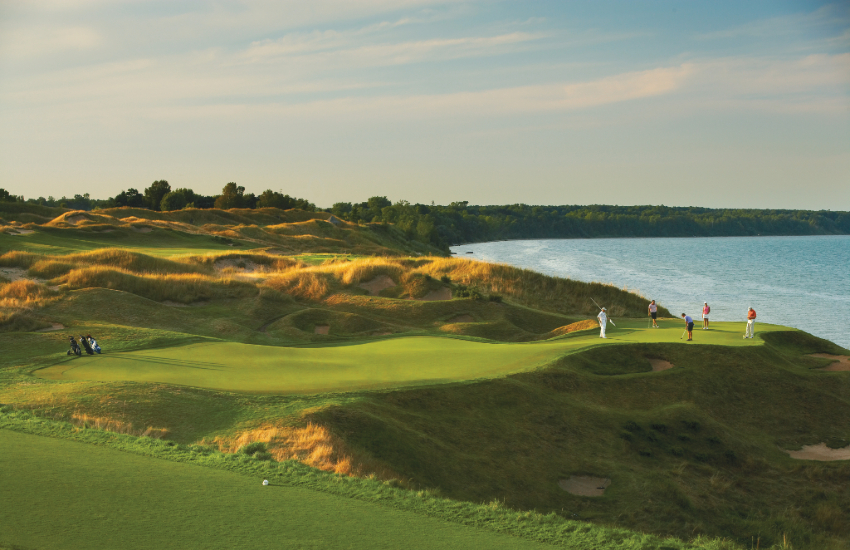
Pete Dye hauled in some 800,000 cubic yards of sand and dirt to turn a pancake-flat stretch of Lake Michigan shoreline into something that looks airlifted straight from the coast of Ireland. Then he added the bunkers. Golf Digest counted 1,012 at last check, which tells you two things: there’s sand everywhere, and somebody actually tried to count.
Some of that sand hides in plain sight, too. Just ask Dustin Johnson, who lost his shot at the 2010 PGA Championship after grounding his club on the 72nd hole in a bunker he didn’t realize was a bunker. If a major champion can’t always tell where the hazards are, what chance do the rest of us have?
Eight holes hug the lake, which means the wind is a major factor at the Straits. Add fescue-topped dunes and greens kept at tournament speed, and you’ve got a course that hosted the 2021 Ryder Cup without needing to change a thing.
3. The Ocean Course at Kiawah Island Golf Resort
Kiawah Island, South Carolina
The Ocean Course has the most seaside holes in the Northern Hemisphere: ten right on the Atlantic, the other eight running parallel. Pete Dye’s wife, Alice, suggested raising the whole course so players could see the ocean from every hole. Lovely thought. It also exposed every single shot to the wind, which can swing club selection by as much as eight clubs from one round to the next.
The Ocean Course looks like a links course but doesn’t totally play like one. The Paspalum fairways are soft and grabby, so the low runner that saves you in Scotland dies on arrival here. You have to fly the ball to your target, over scalloped greens guarded by sand, in wind that has its own agenda. That combination gave the 1991 Ryder Cup its nickname, “the War by the Shore,” handed Rory McIlroy a record eight-shot win at the 2012 PGA Championship, and let a 50-year-old Phil Mickelson become the oldest major champion in history at the 2021 PGA. Hard course. Great theater.
4. Carnoustie Golf Links
Dundee, Scotland
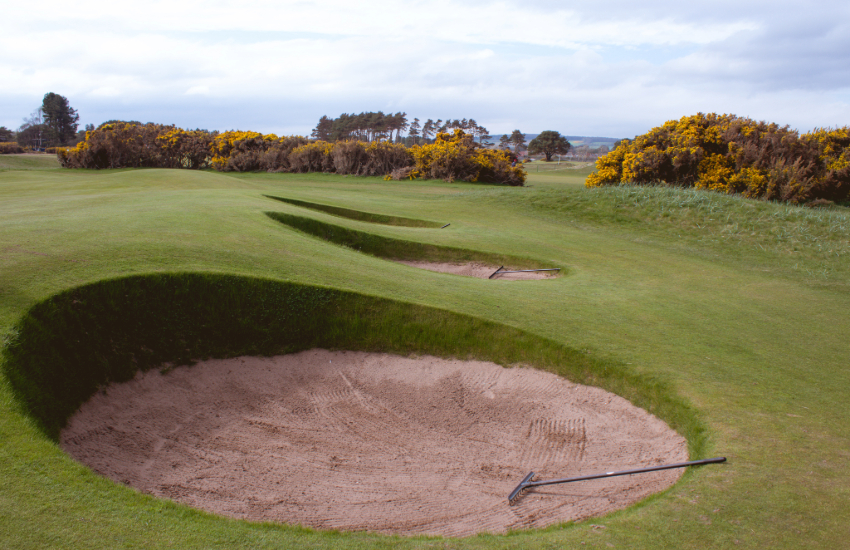
The locals call it “Carnasty,” and the nickname is earned. Carnoustie sits on the windswept Angus coast, where golf has been played for more than 400 years—which is a long time to perfect the art of breaking hearts.
The cruelty here is structural. No more than two consecutive holes run in the same direction, so the wind never lets you settle in; every tee box is a fresh negotiation. The bunkers, many shaped by five-time Open champion James Braid, have steep riveted faces that turn a shot two yards offline into a sideways pitch-out and a short lesson in humility. And then there’s the finish. The final three holes, with the Barry Burn snaking across the 17th and 18th, form what many consider the toughest closing stretch in golf. It’s where Jean van de Velde famously waded into the burn, trousers rolled, and triple-bogeyed away the 1999 Open Championship.
5. Jade Dragon Snow Mountain Golf Club
Lijiang, Yunnan, China
At 8,548 yards, Jade Dragon Snow Mountain holds the Guinness World Record as the longest par-72 course on the planet, including the 711-yard par-5 fifth—the longest par 5 in the world. The only reason any of it is playable: the course sits at 10,000 feet in a Himalayan valley, where thin mountain air adds 15–20% to your carry distance. You’ll hit the longest drives of your life here and still find yourself reaching for a fairway wood on the approach. Neil Haworth’s design has two personalities—a Scottish-flavored front nine and a mountainous back—all of it framed by the snowcapped peak the course is named for.
6. Championship Links at Royal County Down Golf Club
Newcastle, Northern Ireland
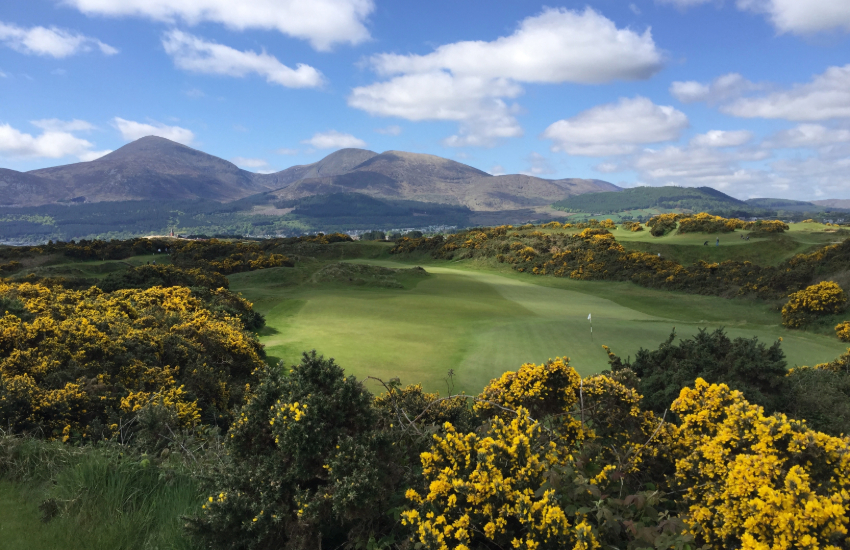
Plenty of courses are hard because of what you can see. The Championship Links at Royal County Down is hard because of what you can’t. This is the home of the blind shot—tee balls launched over dune ridges toward fairways you’re accepting entirely on faith—and of “bearded” bunkers fringed with marram grass and heather that can swallow your ball.
The fairways zigzag between gorse-covered dunes beneath the Mourne Mountains, with the Irish Sea glittering beyond, and the whole thing is routinely ranked the best course outside the United States (some say anywhere).
7. Palm Course, Saujana Golf Club
Kuala Lumpur, Malaysia
The Palm Course is nicknamed “the Cobra,” and both origin stories check out: plantation owners once released cobras on this land to handle the rats, and the routing coils and strikes like one. Built on a former oil palm plantation, it’s not long by modern standards, which is precisely how it gets you.
Exhibit A: the par-3 second. From the tee it looks simple—a short iron over a ravine. It is regularly ranked among the hardest holes in all of Asia. Depth perception in the jungle is a lie, the green repels anything tentative, and the ravine keeps what it catches. That’s the Palm Course in miniature: dramatic elevation changes, fairways lined with palms that swallow anything offline, sloping greens, and the occasional monkey auditing your takeaway.
8. The Stadium Course at PGA WEST
La Quinta, California
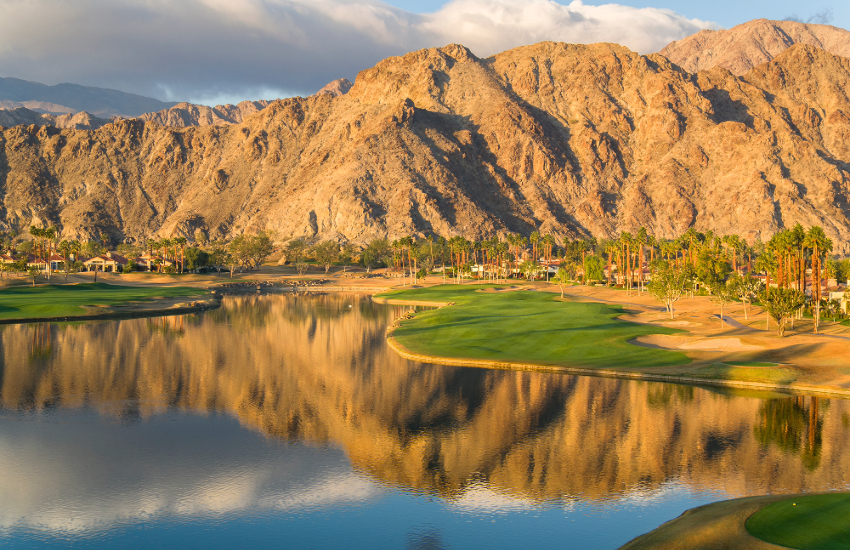
Pete Dye’s third appearance on this list, and arguably his most theatrical. The Stadium Course was built with spectator mounds sculpted right into the terrain—Dye designed the difficulty and the seating to watch you experience it. When it debuted in the 1980s, tour pros complained so loudly about the difficulty that it disappeared from the PGA Tour rotation for over two decades. Yes, the course was too hard for the professionals. Golf Digest has ranked it the 4th-toughest course in America, and today it hosts The American Express every January, presumably because everyone has made up.
The signature terror is the island-green 17th, named Alcatraz—a rock-walled green marooned in a lake, where Lee Trevino made a hole-in-one at the 1987 Skins Game and roughly everyone since has made memories of a different kind. It’s followed immediately by a water-lined 18th, one of the meanest one-two closing punches in golf. Five sets of tees stretch up to about 7,300 yards, so at least you get to choose your portion of punishment.
9. Cape Kidnappers Golf Course
Hawke’s Bay, New Zealand
Tom Doak routed Cape Kidnappers across a series of clifftop ridges—long fingers of land split by deep ravines, ending in sheer drops of more than 400 feet to the Pacific. Several fairways run straight out along those fingers toward the ocean, which means the penalty for a miss isn’t a bunker or a red line. It’s the sky.
The par-71 layout plays about 7,100 yards, but the number undersells it. The wind arrives off the ocean with nothing to slow it down, the fairways are firm and fast, and the greens sit exposed on the ridgelines. The par-5 15th—named Pirate’s Plank, because of course it is—runs 650 yards dead toward the cliff edge, where the fairway simply ends at the horizon. Few shots in golf clarify the mind quite like a downwind approach with the Pacific waiting 400 feet below your landing area.
10. Ile Aux Cerfs Golf Club
Ile aux Cerfs, Mauritius
Two-time Masters champion Bernhard Langer designed Ile aux Cerfs Golf Club on its own island off the east coast of Mauritius, and he used every acre against you. Nine lakes. Volcanic rock. Gullies, mangroves, and tropical foliage crowding the corridors. Three holes require carries over ocean inlets just to find the fairway, and every hole offers a view of the Indian Ocean—along with several creative ways to put your ball in it.
The saving grace is the conditioning: the Seashore Paspalum turf loves the tropical climate and keeps the surfaces immaculate, so the course never adds sloppiness to its list of defenses. And when your round ends, you’re still standing on a paradise island in the Indian Ocean, which has a way of softening any scorecard. Funny how a rum cocktail and a sunset can reframe a triple bogey.
Here’s the good news about the hardest golf courses in the world: you don’t have to be a tour pro to play them, and you certainly don’t have to break 80 to love them. The one thing you do need? Your own clubs. Nobody wants to face Carnasty or Alcatraz with a rental set, and nobody wants to drag a travel bag through three airports to avoid it. ShipSticks sends your clubs ahead so they’re waiting when you arrive, and the only battle left is the one with the course. That one’s on you.
