



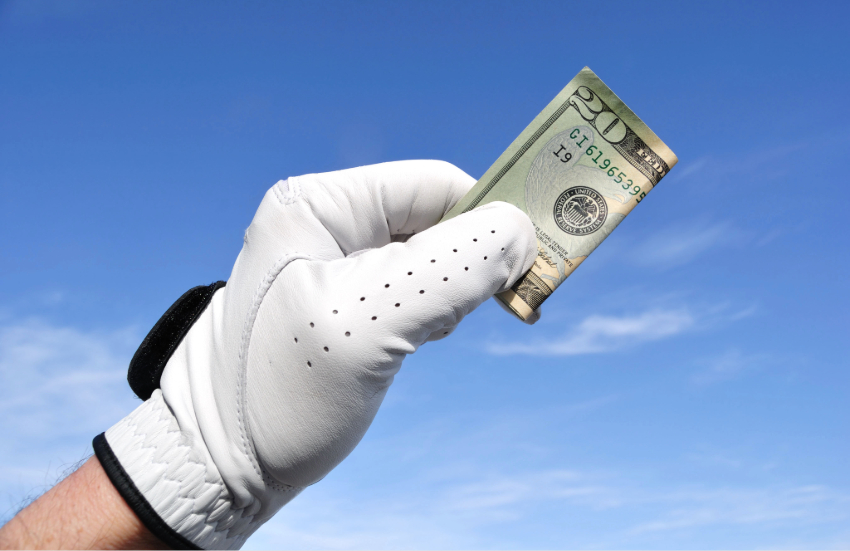
Every group has a Kevin. If you’re a fan of The Office, you know exactly what that means on a golf course. All it takes is the mention of a round for Kevin Malone—accountant, sandwich enthusiast, chili connoisseur, man of otherwise very few words—to reveal he’s secretly fluent in the entire language of golf gambling. Skins, Bingo Bango Bongo, Wolf, Sandies, Barkies, Arnies. He knows them all.
Every foursome has one. The guy who needs a bet on the front, a bet on the back, and something riding on the par-3 nobody else was even thinking about. A little much? Sure. But he’s also the reason your ordinary Tuesday round somehow felt like Sunday at Augusta.
Trouble is, half the group is nodding along without actually knowing the rules. So consider this your cheat sheet. Here are four of the most popular golf betting games, broken down into plain English: how they work, how to keep score, and who each one is best for.
Golf Betting Games: The Stakes
Before we get into it: decide what you’re actually playing for before you tee off. It doesn’t have to be money. A dollar a hole, the loser buys lunch, or a made-up trophy that lives in someone’s garage all work just fine. The point of these games is to add a little spice, not to end friendships. Set the stakes low enough that everyone can shrug off a bad day and high enough that a three-footer on 18 actually feels like it’s worth something.
Golf Betting Games: Nassau
A Nassau isn’t really one bet, but three. You’re playing a separate wager on the front nine, the back nine, and the overall 18. So a “$5 Nassau” means $5 on the front, $5 on the back, and $5 for the entire round. That’s $15 in play, but three different ways to win. It’s typically match play, though you can play it as stroke play. That’s just far less common.
That three-part structure is what makes Nassau so appealing. If you’re getting smoked on the front nine, the back nine offers a clean slate, and the overall is still up for grabs. Nassau works with straight-up scores or with handicaps (giving strokes so a mid-handicapper can compete with the group’s ringer). You can play it head-to-head or two-on-two as a team.
The press. Here’s the wrinkle that makes Nassau dangerous. If you fall behind during a nine, usually by two holes, you can call a “press,” which starts a brand-new bet from that point forward, running alongside the original one. It’s a chance to win your money back, but if it backfires, you’re now losing two bets instead of one. Presses can stack up fast, so agree ahead of time whether they’re automatic, optional, or off the table entirely.
Golf Betting Games: Skins
In a Skins game, every hole is worth a “skin,” which is a set amount everyone’s playing for. Whoever posts the lowest score on that hole wins the skin outright. Simple enough. The twist is that there are no ties. If two players tie for the low score, nobody wins the skin, and it carries over to the next hole.
That carryover is what makes Skins great. Pots build. By the time you reach a par-3 carrying four holes’ worth of skins, a single tee shot can be worth more than the rest of the round combined.
Like Nassau, Skins can be played gross (raw scores) or net (with handicap strokes) to level the field. A common house rule is “validation”—to win a skin, you have to at least match your winning score on the next hole, which cuts down on one lucky chip-in stealing a fat pot. Optional, but it keeps things fair.
Golf Betting Games: Wolf
Wolf is the most tactical game on this list, and the most fun once everyone gets the hang of it. It’s built for exactly four players.
On the first tee, set a rotation order by drawing tees or flipping a coin. That order determines who the “Wolf” is on each hole, rotating so everyone gets an equal number of turns (four apiece over the first 16 holes, with the last two sorted however your group likes).
Here’s how a hole plays out. The Wolf tees off last and watches everyone else hit first. Immediately after any player’s tee shot, the Wolf can pick that player as a partner for a two-on-two match, but they have to decide right then, before the next player tees off. Like that smashed drive down the middle from your buddy Dave? Grab them. Wait to see Janet’s shot instead? You’ve passed on the first player for good.
If the Wolf doesn’t like anybody’s tee shot, they can go it alone as a “Lone Wolf,” taking on all three opponents by themselves for bigger points. Feeling really bold? Declare “Lone Wolf” before anyone tees off—a blind bet for the biggest reward of all.
Scoring is by best ball: on each team, only the lowest score counts. A simple, common point scheme looks like this:
If the Wolf took a partner (two-on-two):
Wolf’s team wins → Wolf and partner get 1 point each
The other pair wins → both opponents get 1 point each
If the Wolf went solo (Lone Wolf, one-on-three):
Lone Wolf wins → 3 points, to the Wolf alone
Lone Wolf loses → all three opponents get 1 point each
Plenty of groups tweak the numbers and the highest total after 18 wins.
Golf Betting Games: Bingo Bango Bongo
Bingo Bango Bongo rewards good golf in ways that have nothing to do with raw score, which means the 20-handicapper has a real shot at cleaning up. There are three points available on every hole—one each for Bingo, Bango, and Bongo:
Bingo: the first player to get their ball onto the green.
Bango: once every ball is on the green, the one closest to the pin.
Bongo: the first player to hole out.
Because a point is up for grabs just for being first onto the green, a shorter hitter who plays smart and steady can rack up Bingos and Bongos all day. Add up the points at the end; most points wins.
One rule this game lives or dies by is to honor the order of play. Whoever is farthest from the hole (or the green) goes first—no jumping ahead to snag a Bingo out of turn.
The best golf games happen on trips. The only thing that can ruin one is your clubs not showing up, or showing up in pieces.
That’s the part we handle. Ship your clubs (and luggage) ahead with ShipSticks and skip the airport baggage lines, the oversized fees, and the white-knuckle wait at the baggage claim. Your sticks are picked up from your home, office, or course and delivered straight to your destination—waiting and ready before your first tee time, so you can get right to the important business of taking your buddies’ money.
Planning the trip itself? Start with our guide to planning a hassle-free buddies golf trip.
