



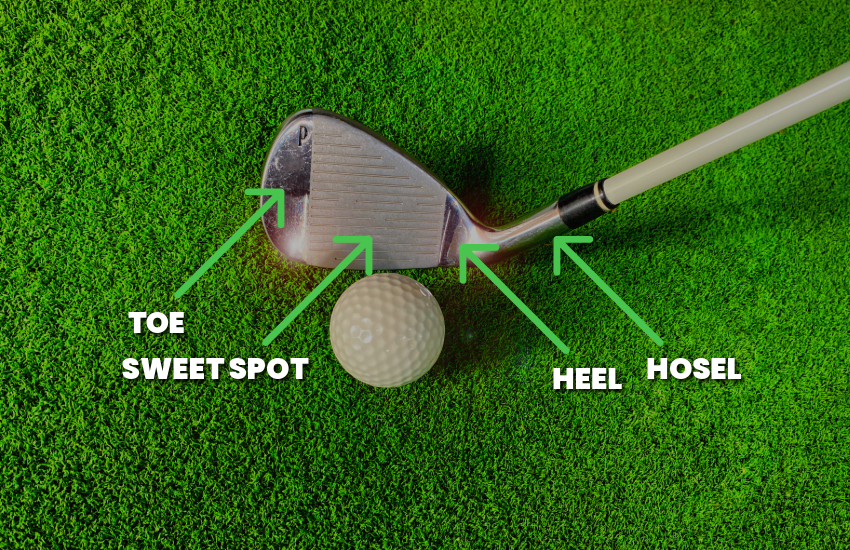
Today, we’re tackling the shank – the most dreaded mishit in golf. That horrifying hosel rocket that sends your ball careening sideways, leaving you staring at your club in disbelief. It’s frustrating, humbling, and somehow, in hindsight, a little bit funny – though you’ll probably need a few deep breaths and a silent count to ten before you can laugh.
Here’s the good news: the shank has a surprisingly well-understood cause, and there are proven ways to prevent it. So next time the dreaded “shanks” strike, come back to this guide – you might just save yourself some frustration (and a few golf balls).
Behind the Golf Shank
What it is:
A shank occurs when the ball makes contact with the hosel, the part of the club where the shaft meets the clubhead.
It doesn’t matter if your clubface is open, closed, or square at impact. A ball hit on the hosel will usually rocket off almost directly to the right (or left, if you’re left-handed), with little to no height and almost no distance.
How it happens:
To strike the ball on the hosel, your swing path is usually off – either too far from the inside or too far over the top. For most amateur golfers, it’s the latter. If you find yourself slicing the ball often, chances are you’re coming over the top.
On the flip side, if your shots tend to hook, you’re likely swinging from the inside.
The key takeaway: shanks are caused entirely by the path of your swing, not the angle of your clubface at impact.
How to get rid of it:
If you’re usually hitting the ball well and suddenly shank one, don’t panic. Step away, clear your mind, and resist the urge to overthink or make immediate adjustments. Chances are, it was just a mishit—and everyone has those.
If, however, shanks are happening consistently, there are a few drills and adjustments that can help:
1. The Board Drill
Grab a long cardboard box or a 2×4 (a club works too, but you don’t want to damage it) and a bucket of balls. At the range, lay the board or box down with one side aimed directly at your target.
Place a ball about half an inch away from the side of the board closest to you. The goal: hit the ball without touching the board. If you’re coming over the top, you’ll find it nearly impossible. Repeat until you get comfortable swinging without hitting the obstacle.
2. Stand a Little Farther Back
Simply increasing your distance from the ball in your stance can help. Being slightly farther away makes it harder to swing over the top, which reduces the chance of contacting the hosel.
3. Rotate the Clubface in Your Backswing
Many shank-prone golfers take the club back with a closed face. Actively rotating the face during your backswing encourages a more natural, around-the-body swing, making it harder to cast or come over the top.
4. Protect Your Confidence
Above all, don’t let the shanks shake your confidence. Sometimes taking a short break from full swings can help. Work on putting, read a golf book, or focus on something else for a day or two. Giving your mind a reset can make a bigger difference than forcing swing adjustments.
Struggling with your short game, too? Check out our expert putting tips for practical advice to sink more putts, boost your confidence around the green, and shave strokes off your score.
